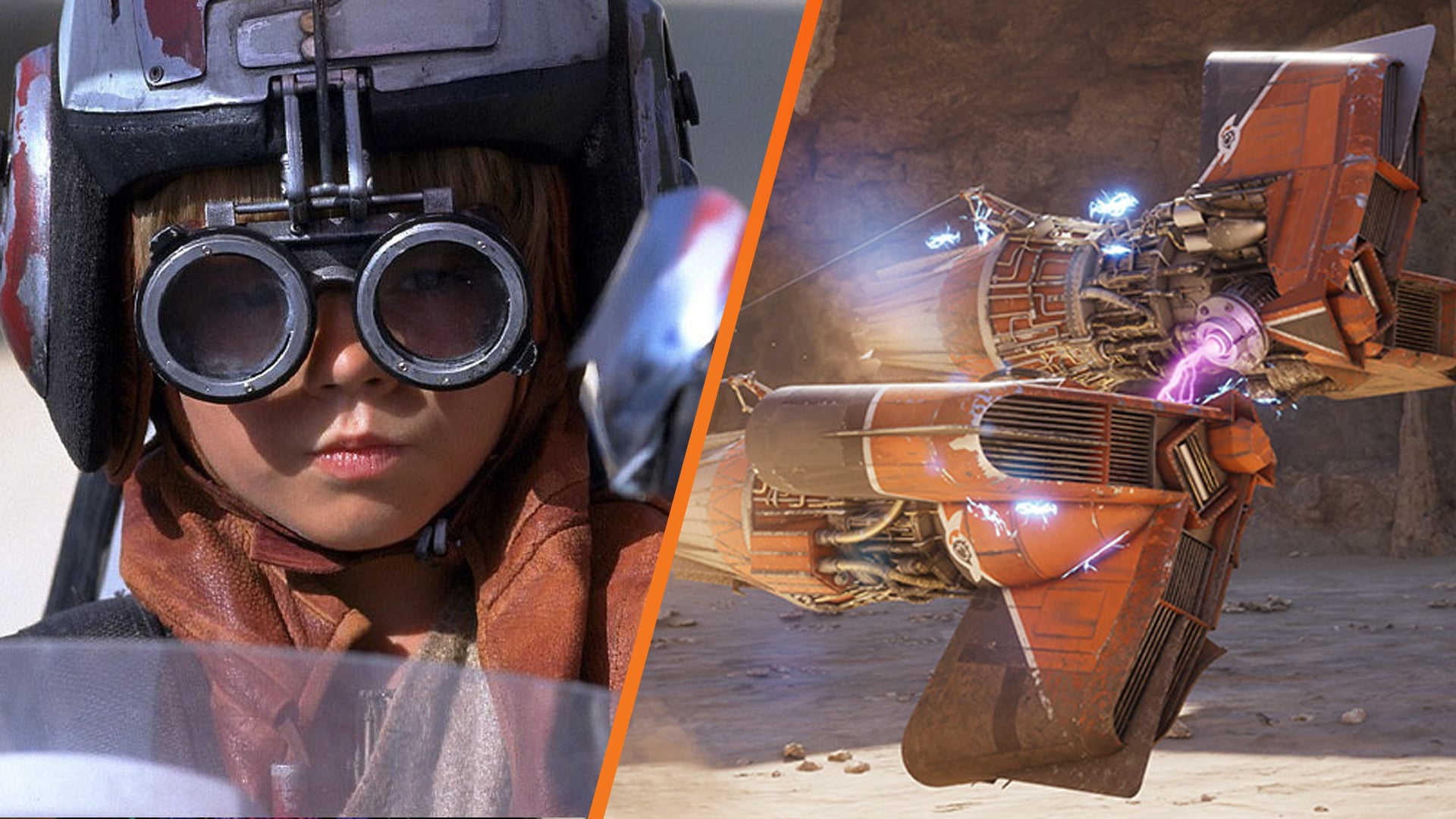
Fuse Games co-founder and CEO Matt Webster says Star Wars Galactic Racer will not let players race as a young Anakin Skywalker when the game launches. Webster told VGC in an interview that the decision comes down to accuracy, not a lack of interest in the character.
The racer is set after the original trilogy, so only characters who are canonically alive during that period can appear in its single-player campaign and arcade modes. Anakin, gone from the saga’s timeline long before the story Fuse Games is telling, does not qualify. At least not yet.
How Star Wars Galactic Racer stays accurate to canon
The question came up because of two legacy racers already confirmed for the game: Sebulba and Ben Quadinaros. Both are pod racers from the Boonta Eve Classic in Star Wars: Episode I. Their presence raised an obvious follow-up: if those pilots made the cut, why not Anakin, who beat them both?
“The thing there is, we need to be accurate, but that’s okay when you have experts,” Webster said. He pointed to the Boonta Eve Classic itself as an example of where the studio draws the line.
“We don’t recreate the Boonta Eve Classic as it appeared in Episode 1, because the outcome of that race is decided,” he said. “But there’s other ways we can use those inspirations and those moments in creative and interesting ways.”
Pushed again specifically on Anakin, Webster did not rule out a future appearance. “Who knows where things will take us. You’ve seen the characters that are available to you right now. What is true is that launch will be a moment, and we’re keen to bring new things to the game post-launch,” he said.
A collaboration with Lucasfilm Games
Webster said the project grew out of an early pitch to Lucasfilm Games. Fuse Games had decided its first title would combine a love of Star Wars with a love of racing games. The studio had worked with Lucasfilm on past projects and used those contacts to propose the idea directly.
According to Webster, picking which era of the timeline to set the game in was one of the most important early decisions. That choice determined which planets, vehicles and characters the team could draw on. From there, he said, the two studios traded ideas back and forth: some came from existing Star Wars material, others were built from scratch to fill a specific creative gap.
The racer is also Fuse Games’ first release as a studio. Asked why a dedicated Star Wars racing game had taken so long to arrive, Webster said he could not point to a specific reason. The idea, he said, felt obvious once the team started building it.
“I don’t know why it’s been so long,” he said, “but you can look back at good ideas and think, wait a minute, that’s a good idea, why didn’t someone think about it before?”
A campaign built on risk and consequence
Beyond the canon question, Webster described a single-player campaign with a heavier structure than a typical arcade racer. Runs carry real consequence: pushing too hard and crashing costs a player their progress, a design choice Webster framed as a fairness trade-off rather than a punishment. Racing “thrives on replayability,” he said, and a progression system that rewards repeated attempts fits how players naturally improve at the vehicles’ handling.
Webster also pointed to the amount of narrative built into the single-player mode, including cinematics, voice acting and new characters introduced specifically for the game. Telling a story was central to working with Lucasfilm Games in the first place, he said, since the Star Wars setting is built around narrative. Some characters still unseen by the public, he added, are ones he expects players to respond to strongly once the game is out.
That same emphasis on fairness carries into how Fuse Games builds its tracks. Webster said courses are designed to look chaotic at racing speed, layered with overlapping routes and shortcuts. The team iterates until a visual language emerges that players learn to read on repeat runs. A crash becomes a lesson a player remembers rather than a random setback, he said. That distinction, in his view, separates a rewarding arcade racer from a shallow one.
Multiplayer racing and the road to launch
Alongside the interview, VGC also published new footage of the game’s multiplayer mode. Multiplayer races run as a series of heats: players who finish well earn credits and upgrades for their ship, carrying that progress into the next race. The format culminates in a finale where every racer’s fully upgraded craft competes for the win. A player who struggled early can still recover by the last race.
Before each heat, players can also place a bet on where they will finish, or target a specific rival, for a bonus payout if the prediction lands. The multiplayer races span three planets: one icy, one volcanic and one covered in grass, each with its own environmental hazards. The finale takes place in a single stadium that combines all three.
The game also includes a separate pod racing arcade mode, playable solo or with other players. The Boonta Eve Classic’s cast of legacy racers shows up there too, outside the main campaign, and it carries the same difficulty as the single-player version.
Star Wars Galactic Racer launches October 6 for PC, PS5 and Xbox Series X|S. Fuse Games has also detailed a Deluxe Edition priced at $79.99/£64.99/€79.99. It adds three bonus vehicles, three deluxe arcade events, a livery pack, a player banner pack and a digital art book.
A physical Collector’s Edition costs $159.99/£139.99/€159.99. It includes a model of the Kor Sarun: Darc X landspeeder, a physical banner, two pilot patches, a printed art book, and a custom slipcover and steel case.
Whether Anakin Skywalker eventually joins the roster remains an open question. For now, Webster’s answer is the same one Fuse Games has given since the game’s reveal: the timeline comes first, and everything else follows from there.