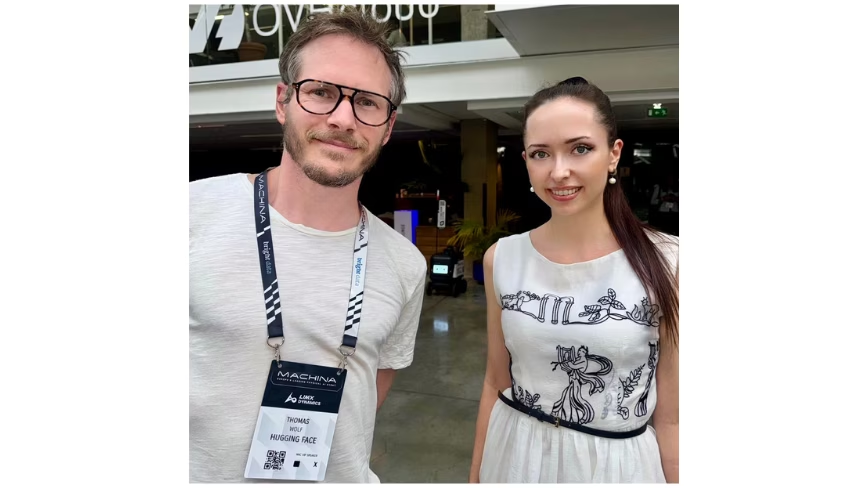
Hugging Face turned down a $500 million investment from Nvidia in January, according to the Financial Times. On August 27, 2026, Nvidia agreed to buy the entire company anyway, this time for $12.9 billion, according to The Information. The price values Hugging Face at roughly 86 times its $150 million in annualized revenue, and nearly triple the $4.5 billion valuation the company carried in 2023.
The Hugging Face Nvidia acquisition lands the same week Nvidia reported $96.2 billion in quarterly revenue and forecast a 70 percent jump in sales for its next fiscal year. At that pace, $12.9 billion covers about thirteen days of Nvidia’s business. For a company that already dominates the chips behind most large AI models, the deal buys something it does not yet control: the open-source layer where developers build.
Why Thomas Wolf sold this time
The irony is not lost on anyone who has followed the company. Hugging Face turned Nvidia’s money down once already; this time, Nvidia bought the entire business. For Thomas Wolf, the company’s co-founder and chief science officer, the calculation was never about a payout. It was about who controls the open-source world he spent a decade building, and that world now belongs to Jensen Huang.
Wolf never planned to sell hardware. He built his reputation, and a company now priced at $12.9 billion, on doing the opposite. Hugging Face became known as the “GitHub for AI models,” a platform where researchers shared open-source neural networks for free. Wolf describes his approach simply: follow the talent, then follow the problem. “I actually always wanted to work with people I really wanted to work with,” he says. That instinct carried him from theoretical physics to patent law to quantum computing, and now to a warehouse full of robot arms.
From software hub to robot warehouse
This summer, Hugging Face is releasing its second consumer robot kit, the Reachy Mini, priced between $399 and $499. The first version, launched last year at around $100, has already sold more than 10,000 units, and the company expects to sell 20,000 more this year. “People are really excited,” Wolf says. “I’m actually very, very excited about this new one.”
The robotics pivot started with software. Hugging Face released an open-source robotics library that gained traction quickly, but Wolf noticed a bottleneck code could not fix. “Hardware was very expensive,” he says. “Even the cheapest ones are still like several thousand dollars, $7,000 to $10,000, $20,000 to $30,000, $50,000.” Hugging Face built the cheapest credible entry point it could find, and demand followed. The company acquired French robotics startup Pollen Robotics, which now forms the core of its physical AI division and pairs the company’s open-source software stack with affordable hardware.
The Reachy Mini is not the only robot Hugging Face is shipping this year. On the day the Nvidia deal was reported, Wolf unveiled Microduck, a 25-centimeter open-source biped with 15 actuators and a full sensor suite, including a camera, speaker, LiDAR, NFC, Bluetooth and Wi-Fi. It ships with more than half a dozen pre-trained policies so it can walk, sit, crouch, roller-skate, pick up objects with its articulated beak and recover on its own, all for $399. Wolf calls it “the first truly accessible RL robot.” Order volume for Microduck reached more than $2.6 million after the launch announcement.
An open-source arms race with China
Wolf points to GLM 5.2, released by Chinese AI lab Z.ai weeks before this interview, as the latest sign of how fast open models are closing the gap with closed ones. “GLM 5.2 which was surprisingly close to Opus 4.8 or Frontier,” he says. “Every year, every few months, having this open source model that suddenly makes a jump, extremely good, I think it’s fascinating.”
His personal favorite right now is Google’s Gemma 4, which he calls small enough to run locally. Wolf says his team recently ran an experiment involving more than 100 AI agents collaborating on an open project, which squeezed a fivefold inference speedup out of Gemma 4 inside vLLM. He calls it one of the most interesting emergent behaviors he has seen from a swarm of agents. The Hugging Face model hub now hosts more than 4 million models, including over 3 million added in the past year alone, though Wolf admits even he cannot test them all.
The cloud business behind the deal
The headlines around the acquisition focus on models and robots, but Hugging Face is already a cloud company, and that may be the real reason Nvidia wrote the check. The platform runs Inference Endpoints, dedicated GPU APIs that range from $0.03-per-hour CPU instances to $80-per-hour clusters of eight Nvidia H100s. Developers can host demos on Spaces, paying by the hour for GPU time, or route API calls through Inference Providers, a billing layer connecting users to third-party GPU clouds such as Together AI, SambaNova and Groq.
Hugging Face and Nvidia already operate Training Cluster as a Service, a joint product giving any of Hugging Face’s 500,000 organizations on-demand access to large GPU clusters, billed only for the length of a training run. It functions as a distribution channel for Nvidia’s compute, built inside a developer tool. That channel matters because Nvidia’s own cloud offering, DGX Cloud, was scaled back roughly a year ago. Owning Hugging Face gives Nvidia a route back into cloud computing without starting over: a platform where developers already rent GPUs, pay for inference and trust the brand.
There is a balance-sheet angle too. Nvidia has committed to covering tens of billions of dollars in cloud computing deals for its largest customers, and unused capacity from those deals could become a liability. Hugging Face gives Nvidia a ready-made customer base of millions of developers and thousands of enterprises to absorb that capacity. Hugging Face’s cloud services, storage and subscriptions produced roughly $150 million in annualized revenue this summer, up from about $100 million two months earlier. Nvidia is not buying that revenue line. It is buying the distribution layer for the one corner of AI that keeps developers tied to CUDA while OpenAI, Google, Amazon and Anthropic build their own chips.
What the Hugging Face Nvidia acquisition means next
The Hugging Face Nvidia acquisition does not erase the rest of the company’s roadmap. Hugging Face has made six acquisitions so far, all small and talent-driven. “We’re acquiring regular AI companies,” Wolf says. “We look for very high talent, small companies that match our software culture, open source.” The company recently partnered with Qualcomm to optimize AI inference on edge chips. It has also moved into enterprise storage: the hub holds petabytes of model weights and datasets, so its engineering team built a blob storage system efficient enough to sell to outside customers. In June, AI lab Arcee became the first major American company to replace Amazon Web Services’ S3 with Hugging Face Private Storage, in a multi-million dollar commercial partnership.
The deal has not closed and remains subject to regulatory approval. Wolf turned Nvidia down once, when the chipmaker offered $500 million for a stake at a $7 billion valuation. This time he said yes to a full sale at nearly double that valuation multiple. He is not framing it as a retreat from open source. “I think AI was this fascination about how is this intelligence made,” he says. Whether Nvidia lets him keep running Hugging Face the way he has for a decade, giving away the software and selling the infrastructure underneath it, is the question the rest of the industry will be watching once the deal closes.