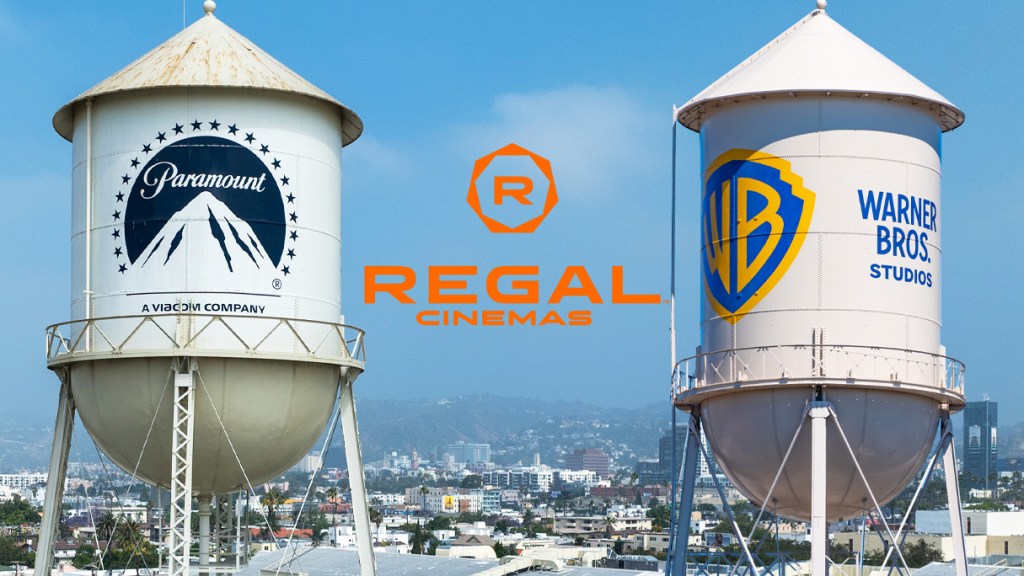
Paramount has made a written commitment to guarantee 30 films a year for three years to at least one major theater chain. The offer is meant to ease antitrust concerns tied to its proposed Warner Bros Discovery merger. Deadline has learned the commitment goes to Regal and includes an exclusive 45-day theatrical window, followed by a 90-day window before titles move to streaming. It arrives as the Paramount Warner Bros merger case heads toward trial before state regulators.
The commitment matters because Cinema United, the trade group formerly known as the National Association of Theatre Owners, remains opposed to the merger. Regal and AMC are the two biggest chains in the country, and both have signaled support for the deal even as most of the group’s other members push back. AMC chief Adam Aron has publicly backed a Paramount-Warner Bros Discovery tie-up, and Regal boss Eduardo Acuna has done the same.
The strategy behind the offer is narrower than a blanket pitch to the whole exhibition trade. Paramount is going circuit by circuit, starting with the two chains large enough to move public opinion on their own. Locking in Regal and AMC first, rather than negotiating with Cinema United as a bloc, lets the studio claim exhibition support. The trade group as a whole still opposes the merger.
Inside the Paramount Warner Bros merger deal with Regal and AMC
There is buzz that AMC has also received a written commitment from Paramount, but Aron declined to confirm it. He told Deadline on Sunday afternoon, “AMC has no comment on this story, period. Nor have we ever had any comment on this story.”
Acuna, by contrast, confirmed that Paramount CEO David Ellison is negotiating in good faith. “David is sincere in making these commitments, and he has offered to execute a consent decree to the state AGs to that effect. These are tangible and important commitments that will benefit the industry and which can be measured,” Acuna said.
Paramount insiders told Deadline that no written commitments have gone out to exhibitors yet. Ellison is willing to offer similar terms to any chain that wants them, backed by financial penalties if Paramount breaks the agreements. The offers extend promises Ellison made at CinemaCon to keep a large theatrical slate and favorable release windows in place.
The window structure itself carries weight for exhibitors. A guaranteed 45 days of exclusivity before a film reaches streaming is a stronger position than the informal arrangements most chains currently rely on, especially backed by a written and enforceable agreement. Penalties for breaking it give theaters recourse they would not otherwise have if a merged studio later shortened windows to boost its streaming numbers.
Why the rest of the industry isn’t convinced
Cinema United has continued pressing for a meeting with Ellison over its broader concerns, though nothing is on the calendar yet. The group argues that combining Paramount and Warner Bros Discovery will shrink the total number of films released each year, no matter what Paramount promises individual chains. Fewer films, the group says, will eventually force theaters to close, with a ripple effect on the Main Street and mall economies built around them.
For Regal and AMC, the calculation is different. Locking in a guaranteed 30-film slate matters more than the industry-wide debate, especially while Paramount and Regal are still negotiating future terms on that slate. Being on good terms with Paramount now could shape those numbers later.
Cinema United’s objections are not limited to film counts. Fewer releases from a combined studio also means fewer jobs across production and exhibition, an angle the group has raised alongside its box office arguments. Deadline understands that concern remains unresolved even as Regal and AMC negotiate their own terms separately.
The Disney-Fox merger as a warning sign
Precedent drives Cinema United’s skepticism. In 2016, Disney and 20th Century Fox released 26 wide titles between them, each opening in more than 2,000 locations. By 2025, in the years since Disney absorbed Fox, their combined output had fallen to 14 wide releases, a 46% decline. Combined box office from the two studios dropped from $4.29 billion in 2016 to $2.4 billion in 2025, down 44%.
Major studio executives raised monopoly concerns with the Justice Department when the Disney-Fox deal was under review, and regulators allowed it anyway. Cinema United points to the falloff that followed as evidence that a Paramount-Warner Bros combination could follow the same pattern, whatever commitments get made on paper now. The group has not addressed how the two situations differ, only that the outcome could look similar.
What happens before the trial
The antitrust trial with the state attorneys general isn’t scheduled until March 2027. For now, Paramount has 16 films dated for 2027 and seven for 2028, while Warner Bros has 19 films set for 2027 and 15 for 2028, according to Rentrak data. Had the merger closed this fall, the combined studio would have had 35 films on the 2027 slate and 22 for 2028.
The trial timing gives Paramount roughly a year and a half to make its case to regulators, and to exhibitors, before a decision comes down. Written commitments from Regal and AMC are part of that case. The stronger Paramount’s public support from exhibition looks, the harder it becomes for the state attorneys general to argue the merger threatens theatrical output.
Meanwhile, the domestic box office is on pace to reach about $10 billion this year, the strongest total since before the pandemic, with the summer haul crossing $4 billion this weekend. That backdrop works in Paramount’s favor. A recovering theatrical market makes the argument that a merger will shrink film output harder to sell, even with the Disney-Fox numbers sitting in the background.
Written commitments do not guarantee output. If films from a combined studio underperform, nothing stops Paramount from scaling back the annual slate regardless of what it has promised on paper. That question, more than the outcome of the Paramount Warner Bros merger case itself, will determine whether Regal and AMC end up with the volume of films Paramount has promised them.