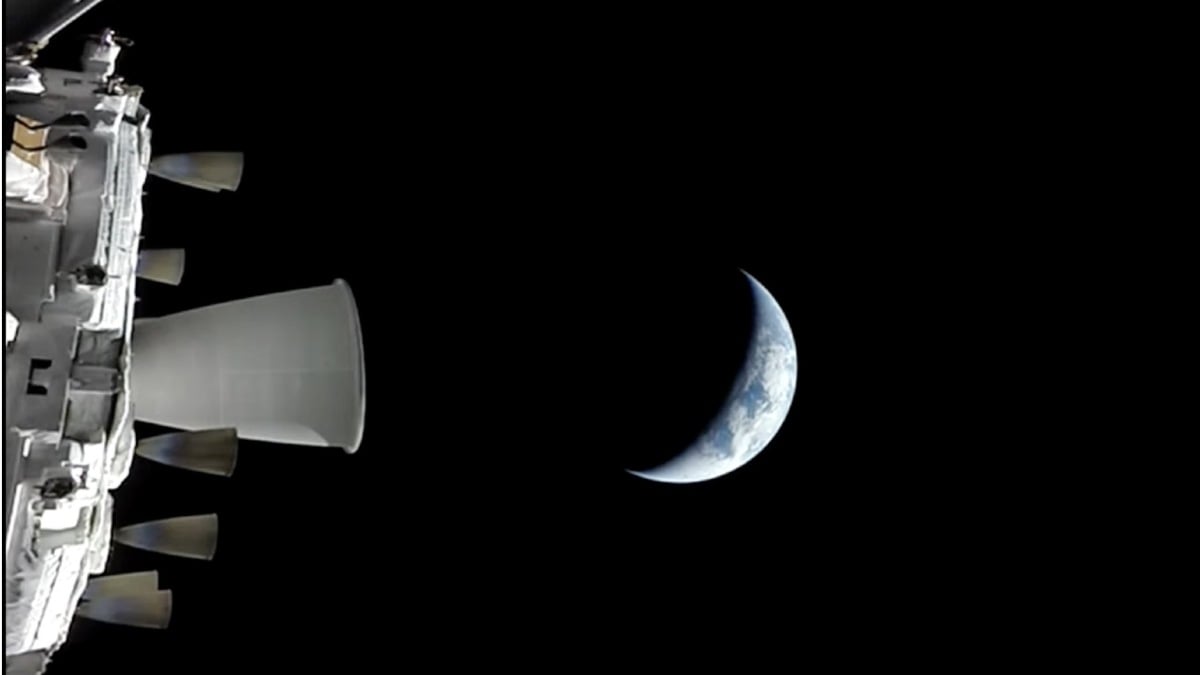
NASA has ignited the engines on its Artemis II mission, propelling the Orion spacecraft and its four astronauts out of Earth’s orbit and onto a direct course to the moon. The six-minute translunar injection (TLI) burn, completed just before 8 p.m. ET on April 2, 2026, represents the mission’s final major engine firing and marks the true point of no return for the crew.
Following a successful launch from Kennedy Space Center less than 24 hours earlier, flight controllers gave the green light for TLI. This maneuver carries significant risk: once executed, the crew is committed to the deep space journey, with only a few slim options for turning back. “There’s no canceling the countdown on this – we are re-entering, but the truth is, we are re-entering at the moment we do TLI.” That’s how crewmember Christina Koch framed the stakes during a pre-launch briefing.
Why This Burn Matters
For everyone involved-engineers, mission planners, and space enthusiasts-this is a critical milestone. Unlike the International Space Station, where astronauts are never more than 90 minutes from an emergency landing, the Artemis II crew is locked into a 10-day, quarter-million-mile loop around the moon. This burn not only propels them outward but also sets up a free-return trajectory: if something goes wrong, the moon’s gravity will sling Orion back to Earth, mirroring the Apollo 8 and Apollo 13 missions.
The mission serves as a shakedown for the hardware and teams preparing for a lunar landing on Artemis IV, targeted for 2028. Commander Reid Wiseman, pilot Victor Glover, and mission specialists Jeremy Hansen and Koch are putting life-support systems, manual controls, and deep-space survival skills through their paces. So far, the crew has managed cold cabin temperatures, some toilet setup challenges, and a middle-of-the-night engine firing that interrupted sleep but was part of the plan.
What’s Next for Artemis II
Over the next three days, Orion will coast toward the moon, carrying its crew farther from Earth than any humans have traveled since 1972. The TLI burn was crucial: it gave Orion the speed to break free from Earth’s gravity, removing the need for major course corrections along the way. This mission is designed to test everything necessary for future, longer lunar stays-and eventually, Mars missions.
The crew is adjusting to life in deep space, troubleshooting as they go. They’ve unpacked extra layers to combat the cold and conducted piloting demonstrations to test Orion’s manual controls, which will be vital for docking with lunar landers on future flights. Every system and procedure is being tested in real time, with ground teams closely monitoring and gathering data for the next phases of the Artemis program.
The bottom line
- Artemis II’s TLI burn commits the crew to a lunar trajectory-no easy aborts from this point onward.
- This mission is a full-scale test for NASA’s next moon landing, with every system and crew action under close scrutiny.
- For the first time in over 50 years, humans are venturing beyond Earth’s orbit into deep space.