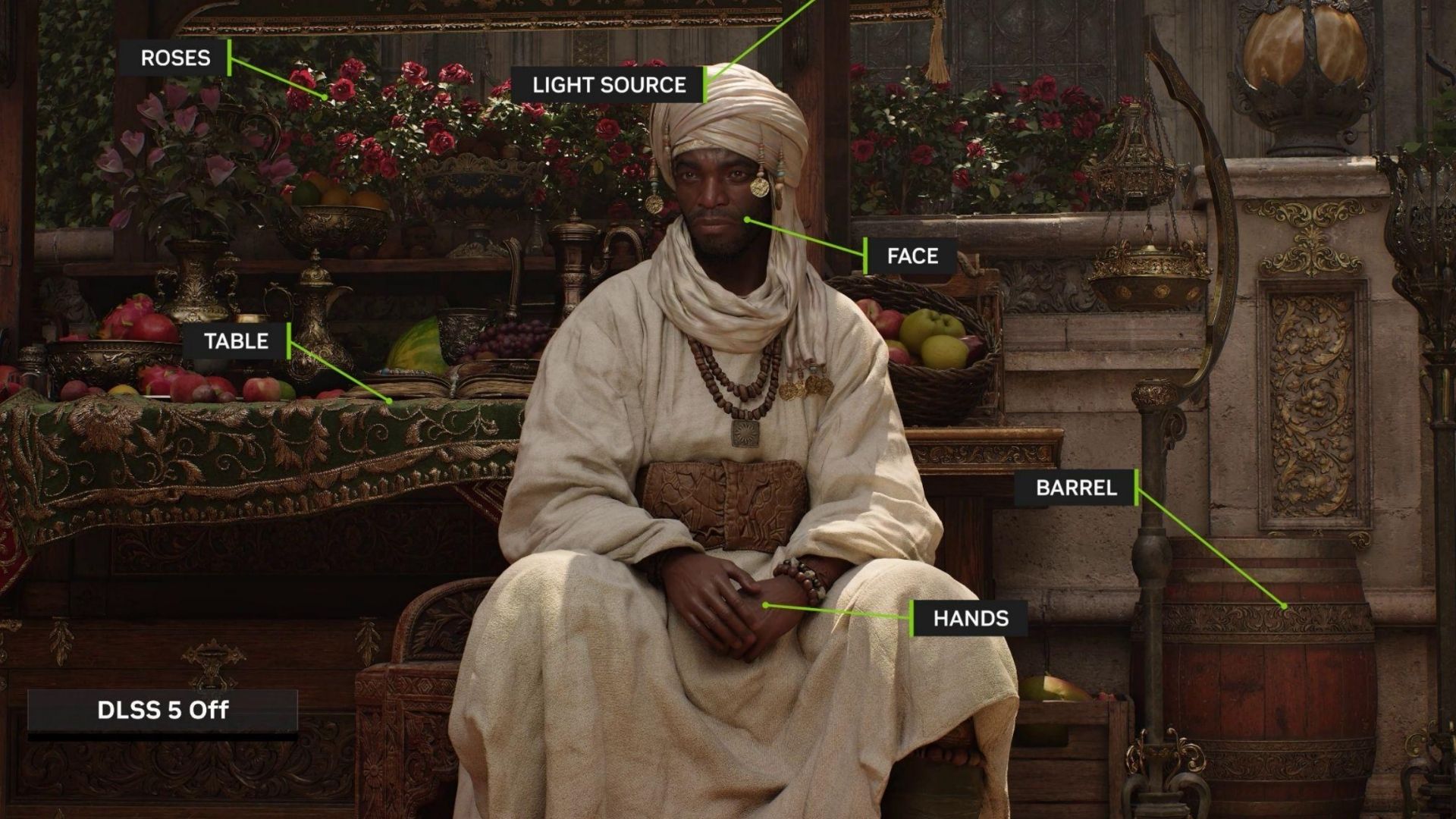
Nvidia‘s next upscaling technology, DLSS 5, launches on September 3, after a reveal earlier this year that drew heavy criticism from PC gamers. At Gamescom last week, Nvidia invited press to a private demo of the tool, walking through its developer controls and fielding questions about how it will change games.
It works very differently from previous versions, and Nvidia had specific answers about who controls it and which games will use it first.
DLSS 5 came under scrutiny when Nvidia first revealed it, because it takes a different approach than earlier upscaling generations. Rather than rendering a frame at lower resolution and using AI to sharpen it, the technology applies what Nvidia calls 3D-guided Neural Rendering, a generative layer placed over an already-rendered frame. The goal, Nvidia says, is “true photorealism” on the best graphics cards, rather than higher frame rates alone.
That distinction is why the reveal caused a stir among players. A tool that reshapes frames for performance is one thing; a generative layer that changes how a scene looks is another.
Some players described the effect as running games through a photo filter, or “yassifying” character models, pointing to how Grace and Leon appear in Resident Evil Requiem footage shared after the reveal. Nvidia’s Gamescom session was, in part, an attempt to answer those concerns directly.
How the neural rendering layer works
The core technology isn’t reshaping frames to boost performance the way earlier DLSS versions did. It adds a generative AI pass on top of what a game already renders, changing, or in Nvidia’s phrasing, improving the image. The first game to support it will be NBA 2K27, arriving on PC this Friday.
Support is limited to Nvidia’s newest hardware. Only RTX 50 Series graphics cards and laptops will be able to run the new system at launch, so anyone on an RTX 40 Series card or older will need to keep using DLSS 4.5 regardless of whether a game adds support for the new version. That narrows the initial audience considerably, even among Nvidia’s own customer base.
Developers get more granular control than expected
One of Nvidia’s engineers, who previously worked as an artist in animation and game development before moving into the DLSS team, walked through the tools studios will use when adding support for the new system. Developers choose between three AI models that adjust art style in different ways, and they aren’t limited to using just one per scene.
They can target specific elements, including background objects, foreground details, clothing, faces, and hair, adjusting each independently through sliders that control tone intensity and structure intensity, similar to adjusting a filter in Canva or Instagram.
Nvidia’s AI masking recognizes individual objects, letting a developer set a parameter for one item without applying it to an entire scene. The demonstration ran inside an internal Nvidia programme called Zorah rather than a live game, so how the toolset performs inside real game engines is still unconfirmed. Nvidia ran the demo with its own engineer at the controls. Whether artists get the same results under deadline on a real production is a separate question.
DLSS 5 is an opt-in tool, not an automatic upgrade
Nvidia representatives confirmed that the system is a separate, opt-in tool. Games that already support DLSS 4.5 or earlier won’t automatically gain the new generative layer; developers choose whether to add it. Nvidia also said it doesn’t expect a developer to opt in without configuring the settings themselves, meaning the AI models are meant to work under a studio’s specific direction rather than by default.
Players will still be able to select which DLSS version they want in a game’s settings menu, though that depends on a title supporting multiple versions. What Nvidia didn’t clarify is how the balance shifts over time. If future performance gains cluster around the newest version, players who prefer older visuals may have to accept generative changes to get them.
Consumers also won’t get the same granular sliders developers do. For players, it will be an on-or-off setting, so anyone who likes how it renders backgrounds but dislikes its handling of character faces has no way to adjust just one part.
Nvidia is aiming DLSS 5 at photorealistic games, for now
Nvidia framed the tool as intended mainly for games chasing photorealism, and NBA 2K27 fits that description as a sports title built to mimic live broadcasts. Leaks ahead of launch point to support in Control and GTA V, however, and neither is strictly photorealistic. That suggests Nvidia’s stated scope may broaden as more studios adopt it, beyond the sports and simulation titles the company used in its demo.
There’s a separate argument to be had about whether photorealism is even a goal worth chasing. Stylized games have proven just as capable of impressing players as realistic ones, and Nvidia’s framing assumes photorealism is the direction most developers want to move in. Whether that holds once the technology reaches more genres than sports sims remains an open question.
Frame rate impact is still unclear
Nvidia hasn’t provided details on how the tool will affect frame rates, unlike earlier DLSS generations that marketed direct performance gains. The Gamescom demo showed image comparisons but no benchmark numbers, and the technology uses frame generation techniques alongside its rendering changes, which makes isolated performance figures harder to pin down.
Because it doesn’t re-render frames at a lower resolution the way older versions do, it shouldn’t lower frame rates outright.
Whether it improves performance without relying on frame generation stays an open question until it ships on Friday and independent testing begins.
What Nvidia showed at Gamescom answers some of the questions raised at the reveal, but not all of them. Developers, not Nvidia, will decide how far the generative layer pushes a game’s look, and players won’t get the same fine-grained say. The RTX 50 Series requirement also means most PC gamers won’t be able to try it on their current hardware, even in games that add support.
For now, the clearest picture of Nvidia DLSS 5 is a tool developers can shape scene by scene, aimed first at photorealistic titles, with its actual effect on frame rates left for reviewers to measure once NBA 2K27 launches this week.