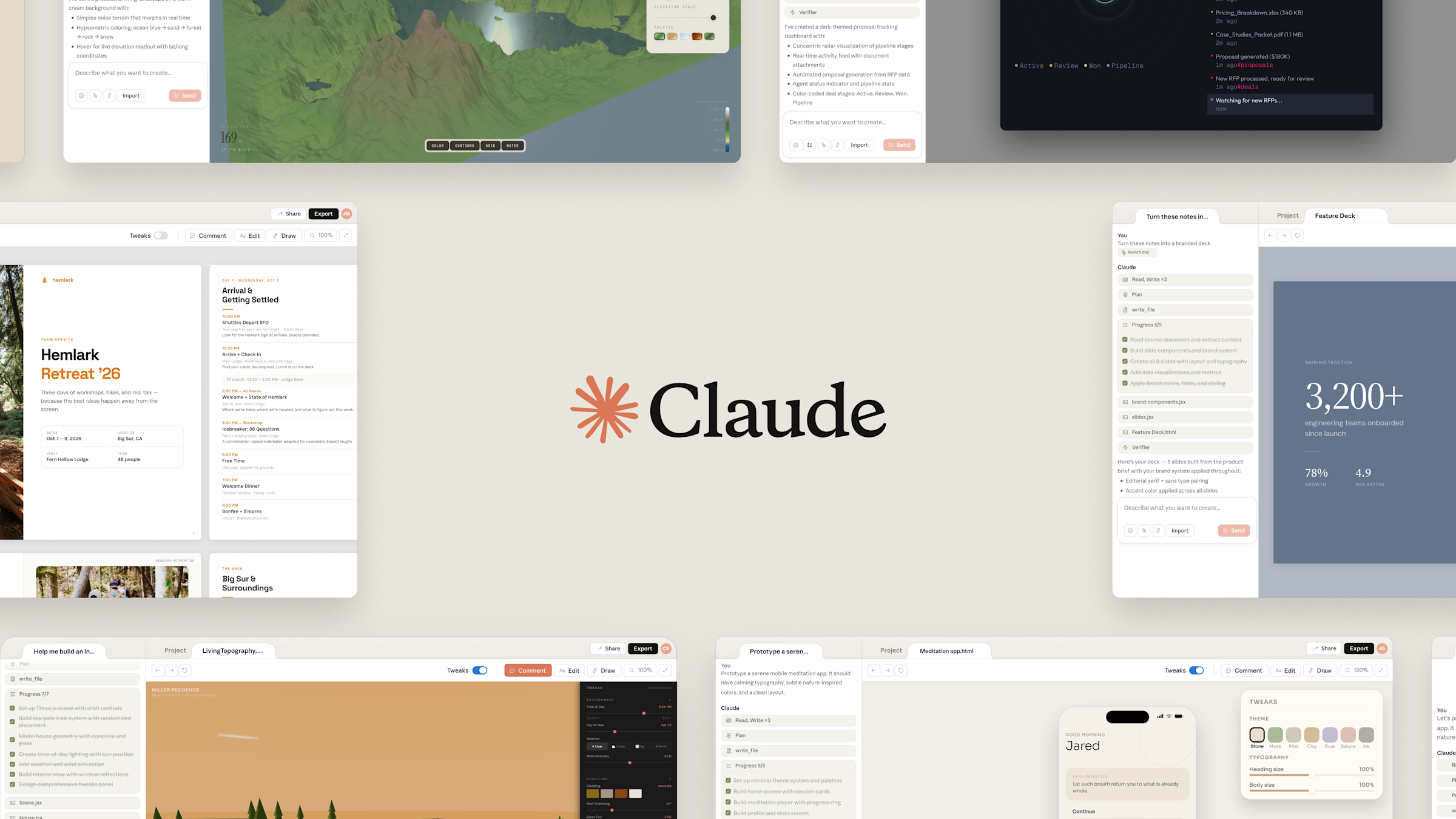
Anthropic has launched Claude Design, a research preview that lets subscribers generate designs, prototypes, and slides from within the Claude platform. The tool is powered by Opus 4.7, which Anthropic describes as its most capable vision model to date.
The announcement comes in the same week that both Adobe and Canva released their own visual AI tools. Anthropic says the goal is to give designers space to explore and everyone else a way to produce visual work without needing dedicated design software.
How Claude Design works
Every project starts with a text prompt. Users can then refine outputs through conversation, inline comments, and direct edits to the generated design. The tool generates custom sliders tied to specific design elements, letting users push and pull values to adjust things like glow intensity, color density, or arc spacing without rewriting prompts from scratch.
Anthropic is careful not to describe the product as an image generator. Opus 4.7 won’t produce photorealistic illustrations or generative art. The focus is on functional, structured output: interface layouts, branded slides, and visual systems designed for practical use in products and presentations.
For teams, Anthropic built an onboarding flow that reads an organization’s codebase and existing design documents to establish an internal visual language. Once configured, every subsequent project automatically applies that organization’s colors, typography, and component styles. The company says this removes the need to re-specify brand guidelines with each new prompt, which has been a recurring friction point with general-purpose AI tools.
Features and export options
Beyond text prompts, the tool supports image and document uploads. Enterprise customers also get a web capture feature that pulls visual elements directly from their company’s website, making it easier to replicate existing brand assets without uploading them manually.
Finished projects can be shared via built-in sharing links or exported directly to Claude Code, which lets developers take a design straight into a working UI build. Export to Canva is also supported, which sets up an unusual dynamic: Anthropic is positioning its tool as a visual alternative to Canva while making the two platforms compatible. More integrations are coming in the weeks ahead, according to the company.
Availability and subscription access
Claude Design is available now as a research preview for subscribers on Anthropic’s Pro, Max, Team, and Enterprise plans. Usage runs against existing usage limits, with no separate pricing tier for the tool. Free plan users are not included in the preview.
The release follows Anthropic adding chart and diagram generation just over a month earlier, part of what now looks like a staged expansion of Claude’s visual capabilities. Three competing visual AI products launching in the same week, from Adobe, Canva, and Anthropic, points to how quickly AI-assisted design has become a priority for major software companies. Anthropic has not confirmed a timeline for when the tool will move out of research preview.